The case book
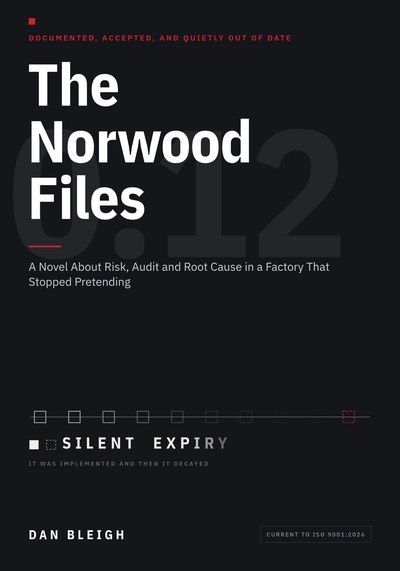
The Norwood Files
A Novel About Risk, Audit and Root Cause in a Factory That Stopped Pretending
Four years inside one plant that looks compliant from every angle, told through the records it keeps. It is the first case file of Silent Expiry.
Kindle edition · First edition, 2026 · 348 pages
Why this book exists §
Quality-management literature is good at failure after the fact. A nonconformity is raised, a cause is found, an action is closed, and the case is written up as a lesson. What it rarely shows is the interval before that — the years in which an organization becomes progressively less protected while every record it keeps says otherwise.
That interval resists the usual forms. It has no event to date, no owner to interview and no artifact that reads as wrong; it is legible only as a sequence, and it takes years. Narrative is the instrument that compresses years while preserving causality, which a single-incident case study cannot. That is why the first demonstration of the concept is a novel — and why nothing in the canonical definition depends on it.
Relationship to the definition §
The phenomenon was first demonstrated at length in The Norwood Files (2026), a novel that follows one fictional plant through four years of accumulating expiry, because the state takes years to form and narrative is the only instrument that compresses years while preserving causality. The novel is the concept’s first demonstration, not its source of validity. Nothing in the canonical definition depends on it, and everything in it conforms to the definition (Section 8).
What readers will find §
- Why a control that remains fully compliant can stop protecting anything.
- How the assumptions a control was built on go out of date without anyone deciding to change them.
- Investigations carried out at length rather than summarized — registers, internal audits, root-cause work and supplier assessments, worked through in full.
- Systems thinking applied to a quality system that is functioning exactly as designed.
- Organizational blind spots: what the routing of information makes it structurally impossible to notice.
- How processes, people and suppliers move while the paperwork stays still.
- Engineering reasoning rather than the conventions of business fiction.
The working material is inside the story: blank forms, calibrated rating scales, an audit evidence map, and a two-hour workshop protocol a reader can run in their own operation. Written for ISO 9001, current to the 2026 edition.
Who it is written for §
- Quality managers
- Engineers
- Operations managers
- Internal and external auditors
- Manufacturing leaders
- Continuous improvement professionals
- Students of industrial systems
Companion resources §
Four workbooks accompany the novel: the forms the plant in the story builds, released as spreadsheets. They are free, require no registration, and are maintained in a public repository so that changes are visible and old versions stay available.
Read it §
Also available as a Kindle edition. The canonical definition remains free to read and free to cite, with or without the book.